Iranian Authorities Target Artists, Writers, and Poets in Escalating Crackdown
Arrests, Incommunicado Detention, and Imprisonments Mounting
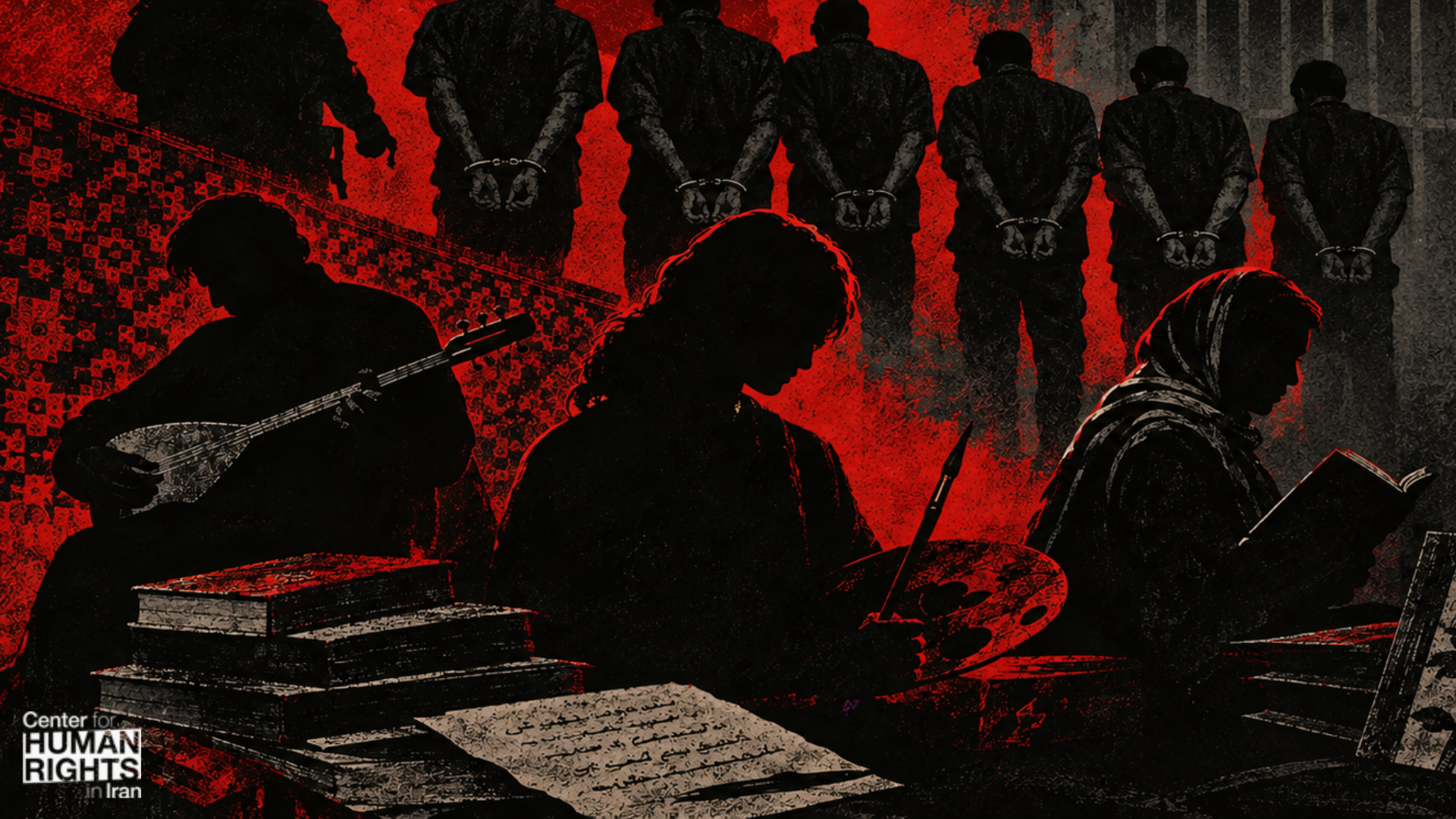
October 6, 2026 — Iranian authorities are intensifying their crackdown on artists, writers, poets, musicians, and other cultural figures, pulling peaceful voices into the same coercive security and judicial apparatus used to suppress dissent across Iran.
In recent weeks, cultural figures have been arbitrarily arrested, detained incommunicado, prosecuted, and imprisoned for songs, poems, paintings, books, social media activity, and other forms of peaceful expression. These individuals are being taken into a system where national-security charges, prolonged detention, coerced confessions, and sham prosecutions can have catastrophic consequences.
The crackdown is particularly acute among members of Iran’s ethnic communities, including Ahwazi Arabs, Kurds, and Lurs, whose cultural expression often provides a peaceful means of speaking about the issues these marginalized communities have long faced. Individuals have even been arrested over work that had official authorization. Security forces have raided homes without warrants and taken individuals to undisclosed locations, leaving families without information about their whereabouts or status.
“These arrests must be understood as part of the broader and increasingly violent campaign of repression in Iran, aimed at silencing dissent and intimidating entire communities,” said Esfandiar Aban, Director of Research at the Center for Human Rights in Iran (CHRI).
“When an artist, poet, or cultural activist is arrested for a song, a poem, or a painting, they are being taken into a judicial system where national security charges can lead to torture, forced confessions, sham trials, and years in prison, and in some cases even the death penalty.”
“For members of Iran’s marginalized ethnic communities, cultural expression is often inseparable from the ability to speak about discrimination, poverty, and the conditions of their communities,” Aban said. “The authorities know this. They want to eliminate peaceful channels through which entire communities can express grievances at a moment when the government is responding to dissent with extraordinary force.”
Key Findings
- Cultural expression is being criminalized. Courts are using songs, poetry, books, and paintings as evidence in national-security cases.
- Literary and artistic work is punished by imprisonment, flogging, travel bans, and restrictions on artistic activity.
- Authorities are using arbitrary detention and incommunicado detention. Arrests are made without warrants, homes are searched, and belongings are confiscated.
- Official authorization offers no protection. Individuals who secured permission from the Ministry of Culture and Islamic Guidance were still targeted by IRGC authorities.
- Ethnic communities targeted. Cases include Ahwazi Arab, Kurdish, and Lor cultural activists, particularly in marginalized regions such as Khuzestan and Kurdistan.
- Artists also face criminal penalties for violating gender-based restrictions.
- Crackdown extends beyond prominent artists. Authorities repressed small literary groups, book clubs, poetry and music circles, mother-tongue advocacy, and other local activities.
“Iran’s authorities have repeatedly demonstrated how a political or cultural case can be transformed into a national security prosecution,” said Aban. “Given Iran’s use of draconian punishments against people convicted on politically motivated charges, the international community must not wait until they emerge from detention with forced confessions and sham convictions before taking action.”
CHRI calls on governments and UN bodies to:
- Demand the immediate release of individuals imprisoned for exercising freedom of expression, and disclosure of the whereabouts and legal status of all detainees.
- Raise individual cases directly with Iranian authorities and through statements by foreign ministries and diplomatic missions.
- Ensure human rights concerns are raised in all bilateral engagements with Iran.
- Impose targeted sanctions against officials involved in arbitrary detentions and the repression of freedom of expression.
- Demand an end to corporal punishment, including flogging.
Arab Artists, Poets, and Cultural Activists Arrested Over a Song
In recent weeks, several cultural activists in cities across Khuzestan Province have been arrested by the Islamic Revolutionary Guard Corps (IRGC) Intelligence Organization, while others have been summoned by judicial authorities. The whereabouts and status of several remain unknown.
CHRI findings indicate that several of these cultural activists and artists were arrested as part of a joint case related to producing and performing a song and publishing it on YouTube, despite having a legal permit.
Mehdi Naseri, head of the Arabic Poetry Association in Shush County, and Aref Naseri, a cultural activist, were arrested in connection with the song From Karun to the Olive Tree, which was produced with official authorization from the Ahvaz Department of Culture and Islamic Guidance. After it was published on YouTube, the IRGC Intelligence Organization intervened and removed it. Its singers, Hossein Ahvazi and Mehdi Zaeri, were also summoned and threatened.
Mohammad Kaabi, also known as “Abu Idris,” and Mehdi Khaledi, an Arab filmmaker and cultural activist from Shushtar, were also arrested in connection with the case.
Source: “This behavior stems from the authorities’ fear of protests erupting, particularly in deprived areas and among economically disadvantaged citizens.”
According to the source speaking with CHRI, IRGC Intelligence agents extensively searched Mehdi Naseri’s home during his arrest, traumatizing his family members and children. The source added that the cultural activists and artists involved in the case had consistently conducted their activities with official authorization and were not underground artists.
“Regarding the cultural activists who were arrested or summoned in this case, it is important to note that these individuals have always carried out their activities with official authorization. In other words, they were not underground artists. As usual, they obtained permission from the Ministry of Culture and Islamic Guidance to produce and release this song. During a meeting, ministry officials emphasized that the lyrics had to directly address Palestine. Although these individuals did refer to the issue of Palestine in their lyrics, the song focused primarily on the problems and hardships facing the people of Khuzestan. This led to authorities taking action against them.
“Almost everyone involved in creating and producing this work was arrested. Even the person who filmed the video was arrested, and so far there is no information about where any of them are being held. The families of these individuals are also under pressure and threat, and many of them, even if they have information, have not disclosed anything so far.”
The source said the song in question explicitly criticized existing conditions, something that security and government institutions found unacceptable. The source said arrests of cultural activists in Khuzestan, particularly in the province’s smaller and economically disadvantaged cities, have continued to increase.
“These crackdowns and arrests have increased significantly in smaller cities. The reason is the influence these activities have among the public, which raises concerns among the authorities. The number of arrests, particularly in recent months, has been seen across all segments of society. This behavior stems from the authorities’ fear of protests erupting, particularly in deprived areas and among economically disadvantaged citizens.
“Under extremely poor economic conditions and amid widespread livelihood problems, there is significant potential for public protests, particularly in border cities and areas that were affected by the war. For this reason, the severe repression of the population, particularly the repression of Arab minorities, such as the activists who have been arrested, has intensified. In the song in question, for example, they openly criticize the situation, and this is completely unacceptable to the security and government authorities.”
Describing cultural activism among Arab minorities in southern Iran and smaller cities, the source said:
“Small book clubs, music, poetry and literature groups, and even groups engaged in religious activities, particularly Sunni religious groups, are subject to extensive surveillance and repression. Many people involved in promoting their mother tongue have also faced pressure and threats in recent months. This remains the case in these areas, particularly for Sunni citizens.”
Arab Cultural Activist Arrested Without Warrant, Held Incommunicado
On September 26, 2026, Asad Halfi, a 37-year-old Arab cultural activist, was arrested after security forces raided his home in the Goldasht neighborhood of Ahvaz and transferred him to an undisclosed location.
According to the Karun Human Rights Organization, IRGC Intelligence agents arrived at Halfi’s home at around 4 a.m. without presenting a warrant, entered the house, searched the property, and confiscated personal belongings before arresting him.
Halfi is married and has two children. He previously managed Qaisar Studio and worked in photography and filmmaking. He was also arrested approximately nine years ago because of his cultural activities and spent a period in detention. After being released on bail, he continued his activities independently and has not engaged in formal activities in recent years.
As of the time of publication, authorities have not provided any information about the reason for his arrest, any charges against him, or his place of detention.
Writer Sentenced to Four Years in Prison Over Instagram Activity
On September 14, 2026, Nima Saffar, a poet and writer from Gorgan who had previously been arrested for his activities, was sentenced in absentia by Branch 1 of the Bandar Abbas Revolutionary Court to four years and eight months in prison. Under the ruling, he was sentenced to eight months for “propaganda against the state” and four years for “engaging in educational activities or promoting deviant activities or activities contrary to the sacred law of Islam.”
A knowledgeable source told HRANA that Saffar’s online activities, including following certain pages or liking posts, were cited in the case against him. Additionally, the case also concerned Saffar’s management of an Instagram page connected to a political defendant in Bandar Abbas, according to the source.
Saffar has a long history of arrests due to work and activism dating back to 2012.
Poet Sentenced to Prison Over Media Activity
On September 6, 2026, Vahid Alizadeh Razazi, a poet and translator, was summoned to to Greater Tehran Prison to begin serving 75 days of discretionary imprisonment. He was notified after appearing before Branch 1 of the Criminal Enforcement Office of the Public and Revolutionary Prosecutor’s Office of District 33, Shahid Moghaddas.
Alizadeh Razazi was previously arrested during the war by security forces on March 23, 2026, and spent approximately one month in solitary confinement before being temporarily released on bail. Security forces also raided his residence and confiscated personal items and electronic devices.
In late July, Branch 23 of the Tehran Revolutionary Court sentenced him to 75 days in prison and a three-year ban on media and social media activities on charges of “acting against national security” and “disturbing public opinion.”
Alizadeh Razazi’s published works include the poetry collection I Am an Esfandi; Please Burn Me Like Wild Rue!. He also translated The Insufferable Gaucho by Chilean author Roberto Bolaño into Persian.
Writer Sentenced to Over Four Years in Prison Over His Work
On September 2, 2026, Rouzbeh Gilasian, a writer from Gorgan, was sentenced by Branch 1 of the Bandar Abbas Revolutionary Court to four years and eight months in prison.
The court sentenced him to eight months for “propaganda against the state” and four years for “engaging in educational activities or promoting deviant activities or activities contrary to the sacred law of Islam.”
Among the evidence cited against him was managing a Telegram channel with approximately 100 members and sharing several of his published books and writings.
An informed source told HRANA: “A number of citizens in Bandar Abbas were arrested following the 12-day war. During the proceedings in their cases, Mr. Gilasian’s name and writings came to the attention of security agencies. He was subsequently arrested as well and faced charges related to the activities of this channel and his works.”
Gilasian, who had been previously imprisoned and faced judicial action for his work, was arrested by security forces in Gorgan in August 2025 and was later released on bail.
Kurdish Literary and Cultural Activist Arrested Without Warrant, Held Incommunicado
On September 23, 2026, Yousef Rahimi, a literary and cultural activist and head of the Hajeh Cultural and Literary Association in Baneh, was arrested by Intelligence Ministry agents on a street in Baneh, Kurdistan Province, without a warrant. Agents also raided and searched his family home and confiscated several personal belongings.
As of the time of publication, no information is available about the reasons for Rahimi’s arrest, the charges against him, or his place of detention.
66-Year-Old Painter Sentenced to Prison Over Paintings and Critical Posts
Rahim Molaeian, a 66-year-old painter and sculptor from Babol, Mazandaran Province, was sentenced to six months in prison on September 13, 2026, by Branch 1 of the Babol Revolutionary Court on the charge of “propaganda against the state.” Authorities reportedly cited his paintings and critical Instagram posts as evidence against him.
In May 2026, security forces searched Molaeian’s office, studio, and home, and seized 28 of his paintings for 48 hours. They also interrogated him three times, each session lasting four hours.
Court Upholds 74 Lashes for Female Singer Performing Solo Without a Hijab
In late September, an appeals court in the city of Qom upheld the flogging sentence against Parastoo Ahmadi, an Iranian singer, along with eight members of her production team and musicians, after a viral virtual concert during which Ahmadi performed without the mandatory hijab. Women in Iran are banned from singing solo and must abide by the mandatory dress code.
The Criminal Court of Qom Province sentenced them in June 2026 to 74 lashes, a two-year international travel ban, and a two-year prohibition on artistic activities. The charges against the defendants reportedly included “offending public decency through the production and publication of vulgar and immoral content on cyberspace platforms.”
The case stems from a performance in December 2024, in which Parastoo Ahmadi and several of her musicians held a symbolic livestream concert without an audience at the Deir Gachin Caravanserai in Qom. After the video gained millions of views on YouTube, authorities briefly arrested Ahmadi and several of her band members and opened a judicial case against them.
Lor Female Artist Arrested and Transferred to Adelabad Prison
Sheida Saberi, a Lor artist from Yasuj who resides in Shiraz, was arrested by Security Police officers on September 20, 2026, and transferred to Adelabad Prison.
As of the time of this report, no information has been released regarding the reasons for her arrest or the charges brought against her.
Saberi has previously been arrested and faced judicial proceedings related to her peaceful activities. On October 8, 2022, during the nationwide Woman, Life, Freedom protests, she was arrested by security forces in Yasuj and released on bail.
“These cases are entry points into a much larger system of violent state repression,” said CHRI’s Aban. “The Iranian authorities are using arrests, interrogation, detention, prosecution, and imprisonment to intimidate entire communities into silence. Cultural repression is increasingly one instrument of a much broader state campaign to prevent Iranians from speaking about the realities they are living through.”
This report was made possible by donations from readers like you. Help us continue our mission by making a tax-deductible donation.