Iran: Deadly Raid on Arab Village Followed by Torture, Forced Confessions, and Threats of Execution
At Least Five Killed, Bodies Still Not Returned to Families After Seven Months, 12 Face Potential Capital Charges
“They have beaten me so badly it seems they intend to kill me”
November 9, 2026 — Last March, Iranian security forces killed at least five residents and arrested numerous others during a deadly raid on Qaleh Chanan, a village near Ahvaz in Khuzestan Province populated by members of Iran’s Arab ethnic minority. The raid had followed protests by residents over worsening economic conditions and took place during the war between Iran and the U.S. and Israel, as the Iranian authorities enforced a nationwide internet shutdown.
More than seven months later, a Center for Human Rights in Iran (CHRI) investigation has found that the authorities continue to withhold the bodies of those killed from their families, while at least 12 detainees face charges that could carry the death penalty amid reports of torture, prolonged solitary confinement, and forced confessions.
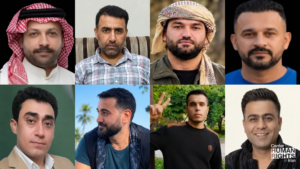
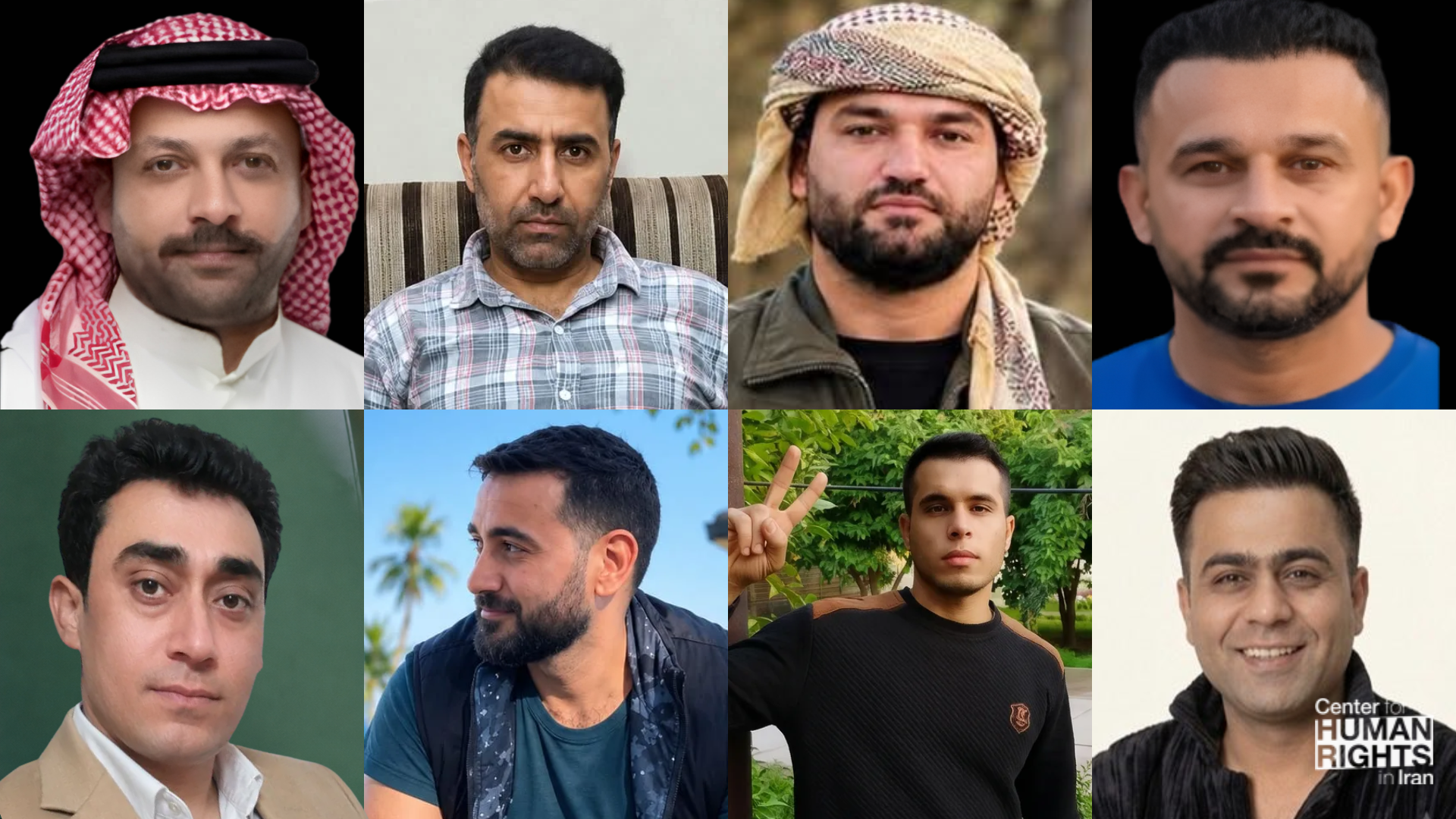
Photos of some of the detained citizens.
All of those arrested have been denied access to independent legal counsel from the time of their arrest. According to information received by CHRI, none had any known prior history of political activity, despite unsubstantiated claims by Iranian security and intelligence officials that they were affiliated with armed opposition groups.
“Iranian authorities have killed residents, concealed their bodies from their families, and subjected those who survived to torture and a corrupt and predatory judicial process that could end in their execution. This is a campaign of state violence in which the authorities are using fabricated accusations and forced confessions to punish a marginalized community and evade accountability for their actions,” said Esfandiar Aban, Director of Research at CHRI.
“What makes the Qaleh Chanan case particularly alarming is the impunity with which the state’s abuses are being carried out. The Iranian authorities have learned they can kill, torture, manufacture ‘security’ cases, and then imprison or even execute people at will,” Aban added. “Most disturbing, there are countless cases like this across Iran.”
CHRI calls on states and UN bodies to demand that the Iranian authorities:
- Disclose the fate of those killed in Qaleh Chanan and return the bodies to their families.
- Ensure that no death sentences are imposed or carried out against the 12 detainees.
- Drop charges and release the detainees on the basis of gross due process violations.
- End the use of torture, ensure forced confessions are excluded from judicial proceedings, and ensure all defendants have unrestricted access to independent legal counsel and contact with their families.
Qaleh Chanan is not an isolated case. Across Iran, particularly in marginalized and minority-populated regions, families continue to face unanswered questions about relatives killed by state forces without investigation or accountability, bodies withheld from burial, and judicial proceedings marked by torture, forced confessions, denial of independent legal counsel, and fast-tracked death sentences. The repeated nature of these abuses points to a broader pattern in which Iranian authorities use state violence and an abusive judicial system against vulnerable communities without fear of consequences.
“The international community cannot continue to treat these abuses as secondary concerns,” said Aban. “The killing of civilians, concealment of bodies, torture of detainees, and prosecution of people on potentially capital charges without access to independent legal counsel demand an immediate and coordinated response. Silence and inaction only reinforce the impunity that allows these abuses to happen again and again across Iran.”
CHRI calls on all States to make the prevention of unlawful executions, torture, and enforced disappearances, accountability for unlawful killings, and due process rights in court explicit priorities in all bilateral and multilateral engagements with Iranian authorities.
What happened in Qaleh Chanan?
CHRI’s investigation has found that the individuals killed and arrested during the March 9, 2026 raid on Qaleh Chanan by national police forces (who are under the authority of the Ministry of Intelligence) had organized demonstrations to protest worsening economic conditions during the war and the internet shutdown. Most of those killed and arrested belong to the Naseri tribe and are relatives.
Although authorities have accused them of “carrying out an armed operation,” informed sources and families in Iran told CHRI that the individuals did not have any weapons and that such accusations are an attempt to fabricate charges and justify the security forces’ killings and prosecutions.
CHRI spoke with Ahmad Hamid, director of the Karun Human Rights Organization, which focuses on human rights issues faced by Iran’s Ahwazi Arab community.
“The pretext and justification given by government and security forces, primarily the Ministry of Intelligence, for raiding Qaleh Chanan was the alleged attack on two Basij centers in the area, which took place a few days after the U.S. and Israeli attacks on Iran and reportedly caused damage to the centers. Security forces and the Ministry of Intelligence used this incident as a pretext to raid Qaleh Chanan and target individuals they alleged were responsible for damaging the Basij centers.
“Government forces raided Qaleh Chanan on March 9 and arrested several residents. Meanwhile, a group of residents fled the area and hid approximately 30 kilometers away, in a place resembling a small natural forest. Government forces surrounded the area and opened fire on the suspects. Five people were killed in the ensuing confrontation, and the others were arrested.”
The intentional killing of fleeing civilians by state security forces represents an egregious crime under international law and a human rights atrocity.
None of the bodies of those killed have been returned to their families. Families do not even know where their loved ones have been buried.
The continued refusal to disclose the whereabouts of people killed by state forces and the withholding of their bodies are grave violations under international human rights law.
Hamid told CHRI:
“Following the raid on Qaleh Chanan, the Ministry of Intelligence issued a statement claiming that the individuals were armed and that, during the confrontation in the wooded area (natural forest), the protesters had also fired at security forces. However, there is no evidence or documentation establishing that the individuals were armed.”
Further details reported by IranWire indicate that on the evening of March 9, special forces known as NOPO (associated with FARAJA, which is Iran’s national police and law enforcement command and operates as its specialized domestic response force), ambushed two vehicles near the village’s marshlands and opened fire as the vehicles arrived.
According to sources who spoke with IranWire and relatives of those involved, the vehicles were carrying residents who had organized the protests over worsening economic conditions and mass arrests across Khuzestan Province. One vehicle initially escaped but was intercepted farther down the road, and its occupants were arrested. The second vehicle drove into the reed beds in an attempt to escape the gunfire. Security forces reportedly continued firing into the area.
Hamid told CHRI:
“The defendants are being subjected to severe pressure and torture to extract forced confessions. These confessions are being used to construct a security narrative against protesters in one of the most deprived and impoverished areas of Khuzestan Province.”
Opaque Judicial Proceedings, Denial of Lawyers, Charges Punishable by Death
During the raid, authorities arrested numerous residents. Due to the lack of transparency from authorities and difficulty obtaining information, the exact number of detainees remains unknown.
However, an indictment issued in recent weeks against 12 of those arrested includes charges that could result in death sentences.
The first hearing was held on October 12, 2026, at Branch 2 of the Karun Prosecutor’s Office, overseen by Judge Vadi-Nejad. In late October, their detention was extended, and another hearing, originally scheduled for October 23, was postponed for a month.
This case is riddled with severe due process violations, reports of torture, and prolonged solitary confinement. All detainees have been completely denied access to independent legal counsel from the moment of their arrest.
CHRI’s source said interrogators have explicitly warned their families that they are not permitted to hire lawyers to represent them.
Detainees were subjected to solitary confinement for over four months at a Ministry of Intelligence detention facility before being transferred to Ward 2 of Sheiban Prison on July 22, 2026. They have also been denied visitation and contact with their families.
According to the Karun Human Rights Organization, Branch 2 of the Karun Prosecutor’s Office has brought three charges against the 12 detainees:
- “Disturbing public order through engaging in clashes and creating a disturbance”
- “Moharebeh [enmity against God] through firing at Basij resistance bases”
- “Armed rebellion against the state [baghi]”
The charges of “enmity against God” and “armed rebellion against the state” are punishable by the death penalty, raising fears that the men could be executed.
Previously, in a statement by the Ministry of Intelligence on March 28, 2026, the detainees, whose names were stated, were accused, without substantiating evidence, of “shooting at security forces, blowing up oil pipelines, possessing Starlink equipment, and cooperating with the United States and Israel.”
The Karun Human Rights Organization has identified the 12 detainees as:
- Tareq Hassanian, 42
- Hamid Hassanian, 42
- Mohammad-Ali Bavi
- Tawfiq Silawi, 30
- Mohammad Nisi, 40
- Hossein Silawi, 20
- Hamed Zohairi (age unknown)
- Bahador Zargani, 39
- Mansour Naseri, 40
- Ahmad Bavi-Fard (age unknown)
- Yousef Hassanian (age unknown)
- Jasem (Milad) Bavi (age unknown)
“They have beaten me so badly that it seems they intend to kill me”: Detainees Subjected to Torture and Forced Confessions
Investigations by CHRI indicate that several defendants were subjected to severe physical and psychological torture during their detention and imprisonment. The difficulty of obtaining information about the cases and the conditions in which the defendants are being held means few specifics are known about their condition.
Based on information received by CHRI, security agencies have used prolonged solitary confinement, torture and threats of severe punishment to obtain forced confessions and advance their case in court.
Hamid Hassanian, one of the detainees and a father of two, said during his brief and only phone call:
“They have beaten me so badly that it seems they intend to kill me too.”
Mahmoud Hassanian, Hamid Hassanian’s brother, was killed when government forces opened fire. A member of the Hassanian family told the Karun Human Rights Organization:
“They did not even give us his body so that we could at least visit his grave. We have also been denied visits with Hamid until now. Hamid is not even allowed to call us.”
Another detainee, Youssef Hassanian (Naseri), 28, was reportedly transferred to Sheiban Prison in Ahvaz after his health severely deteriorated following his solitary confinement and torture at an IRGC Intelligence detention facility.
According to the Karoon Human Rights Organization, interrogators subjected Youssef Hassanian to severe physical and psychological pressure to force him to participate in scripted video confessions.
He was reportedly threatened with being sentenced to “two executions” if he refused to follow the predetermined script and repeat dictated statements on camera.
The torture was reportedly so extreme that his physical condition deteriorated dramatically, prompting authorities to transfer him to Sheiban Prison.
State Continues to Hold Bodies of Killed Residents
At least five people were killed by state forces during the violent raid on the village on March 9. More than seven months later, authorities continue to conceal the killing of these five individuals and deny families their loved ones’ bodies or any information about their fate.
According to a statement by the Ministry of Intelligence on March 28, 2026, five people were killed in the raid, and several others were arrested. However, the statement did not disclose the identities of those killed. The Karun Human Rights Organization has identified two of the five individuals killed as Mahmoud Hassanian and Heydar Khayati-Pour.
Heydar Khayati-Pour was a 32-year-old Arab civil rights activist from Fallahieh (Shadegan). He was his family’s eldest son and sole breadwinner.
Mahmoud Hassanian (Naseri) was born in February 1996 in Abadan and lived in Ahvaz. The family has repeatedly tried to obtain information from various state institutions, but has received no response. They have visited the Intelligence Ministry’s information office, the Intelligence Organization of the Islamic Revolutionary Guard Corps (IRGC) information office, officials at Sheiban Prison in Ahvaz, the forensic medical department, and every hospital in Ahvaz. However, they have received no clear answers and have been unable to locate his body.
“For the families of those killed in Qaleh Chanan, the violence has not ended,” said CHRI’s Aban. “Months later, they still do not know where their loved ones are buried or when, if ever, they will be allowed to retrieve their bodies. For the families of those detained, every day brings the fear that their loved ones are being tortured or could be sentenced to death. The Iranian authorities are inflicting tremendous suffering not only on those they have detained, but on entire families who are being denied even the most basic answers.”
This report was made possible by donations from readers like you. Help us continue our mission by making a tax-deductible donation.