Iran’s Sweeping New Bill Threatens to Isolate Its People From the World
Proposed bill would give intelligence agencies extraordinary powers to monitor citizens’ foreign contacts and impose prison terms of up to 30 years
Iranian Artist: “We will be facing a situation resembling North Korea”
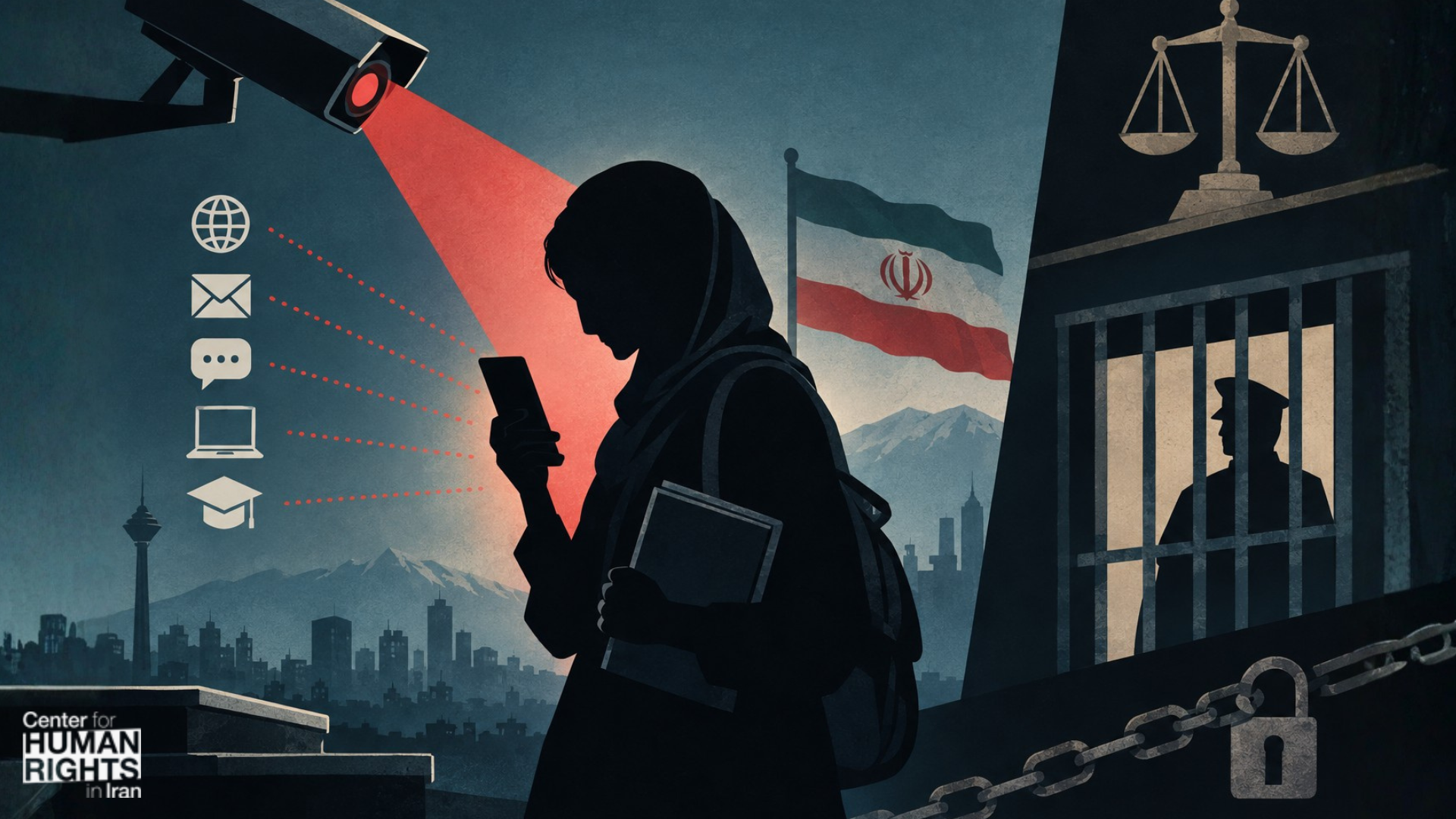
September 15, 2026 — New legislation proposed by Iranian lawmakers last month will impose a sweeping system of surveillance and control over Iranian citizens’ interactions with the outside world, along with severe penalties for vague “offenses” that include imprisonment for up to thirty years.
The bill, which gives extraordinary powers to intelligence agencies to monitor citizens, significantly increases the Islamic Republic’s intensifying domestic repression and will have profound effects on Iranians’ ability to work, study, and communicate with the world, the Center for Human Rights in Iran (CHRI) said today.
“This proposed legislation threatens to turn ordinary academic, professional, and civic engagement into a national security crime. In simple terms, it would criminalize connection to the outside world, further isolating the Iranian people,” said Bahar Ghandehari, CHRI’s director of advocacy.
“The bill’s vague and sweeping language, which gives security agencies with a long record of brutally repressing dissent enormous discretion to monitor people’s activities and determine what is permissible, lays the ground for arbitrary prosecutions,” she noted.
“This legislation would institutionalize the idea that communicating with the outside world is something Iranian citizens must justify to the security services,” Ghandehari said. “That is an extraordinary intrusion into private life and freedom of association. It risks turning the ordinary connections that allow a society to learn, create, work and communicate with the world into grounds for state prosecution.”
Key points of the proposed legislation:
- Gives the security establishment and judiciary sweeping powers to monitor and determine what is unlawful and punish accordingly.
- Contains only vague and extraordinarily broad definitions, prohibiting “any activity or communication” that results in the “violation of independence, national unity, Islamic principles, or national sovereignty…”
- Imposes severe penalties for violations, including up to 30 years’ imprisonment, substantial fines, asset confiscation, professional and employment bans, and the dissolution of NGOs, unions, associations, parties, and other organizations. Penalties can also be increased when alleged offenses involve designated foreign states or agents.
- Criminalizes a wide range of legitimate activities—artistic, journalistic, cultural, and academic—when they are deemed to involve foreign cooperation.
- Activities with “foreign agents and governments” that must be reported include financial transactions, legal services, academic cooperation and scholarships, media interactions, research, cultural and social activities, conferences, artist residencies, and the production of films, theater, and music.
“When the law is so broad, authorities can decide after the fact what constitutes a crime, and citizens cannot know whether carrying out their jobs or studies will put them at serious risk,” Ghandehari added. “Together with the severity of the punishments, the bill will have a profoundly chilling effect on legitimate civic, professional, academic, and cultural life in Iran.”
CHRI calls on international human rights organizations, especially those concerned with freedom of expression and freedom of association, as well as international academic, professional, scientific, and medical bodies, to publicly condemn this legislation and echo the UN’s call for the Iranian authorities to immediately withdraw it.
Although the bill’s details are not yet final, Iran’s parliament approved the general draft outline of the proposed “Countering Foreign Infiltration” by a 183-4 vote on August 16, 2026. The bill’s 33 provisions still need to be approved individually by parliament before it is voted on again and then sent to the Guardian Council for approval. Parliament approved Article 1 on August 19 and Article 2 on September 1, establishing the bill’s core definitions and scope.
Artist in Iran: “We will be facing a situation resembling North Korea.”
The potential consequences are not theoretical for Iran’s citizens, including, for example, its independent artistic community, where international funding, festivals, residencies, and professional collaboration have become essential to artists working outside the state-controlled cultural system.
An individual in Tehran who is active in Iran’s independent cinema spoke with CHRI about the legislation’s impact on the artistic community in Iran:
“If government officials are able to implement this legislation, it would not only make the situation for the freedom of artists and academics extremely frightening, it would also severely affect freedom of expression for all Iranian citizens. We will be facing a situation resembling North Korea. Imagine that every citizen would be required to report to security officials on their activities and reasons for any form of professional or academic engagement with people or entities outside the country. It would create a horrifying situation. In other words, citizens would constantly have to explain and report their personal communications with individuals or organizations abroad to intelligence officials. This is a direct deprivation of freedom and an intrusion into citizens’ private lives.”
Article 1: Vague Language Gives Authorities Broad Power
The bill’s vague and sweeping language is particularly alarming because it gives the security establishment and judiciary sweeping powers to determine what may be deemed unlawful. Iranian authorities have a long history of using vague and overly broad legal terms to criminalize legitimate activities and restrict civil liberties ostensibly in the name of “national security” and “law enforcement.”
For example, Article 1 prohibits “any activity or communication by natural or legal persons, whether Iranian or foreign, that results in the violation of independence, national unity, Islamic principles, or national sovereignty, the weakening of Iranian-Islamic culture, or the facilitation of foreign infiltration and domination over the interests of the Islamic Republic of Iran in political, economic, social, or cultural dimensions.”
Terms such as “national unity,” “Islamic principles,” “weakening of Iranian-Islamic culture,” and “interests of the Islamic Republic of Iran” are vague and not defined in the bill. Their ambiguity gives authorities huge latitude to determine what constitutes a violation, allowing ordinary activities and forms of expression to be redefined as threats to national security or national interests and subjected to criminal penalties.
Article 2: Broad Scope Places Ordinary Activities Under State Scrutiny
Article 2 of the bill, along with its amendments, establishes the bill’s core definitions and scope. It broadly defines who and what would be subject to the proposed law, raising alarm over the sweeping scope of who is considered a “foreign agent” and activities that could be placed under state surveillance and control, including ordinary interactions with foreign media, academic institutions, legal professionals, NGOs, and other civil society actors and institutions outside Iran.
For example, the bill defines “foreign agent” in exceptionally broad terms. The definition encompasses “any non-Iranian government, institution, establishment, or organization, as well as any person operating under their support, employment, direction, supervision, or direct or indirect guidance, whether based inside or outside Iran.” By casting such a wide net, the provision risks subjecting ordinary interactions with non-Iranian individuals and institutions to the bill’s security framework, without requiring evidence that those interactions involve any unlawful conduct.
In addition, “foreign governments” are classified into three tiers, as decided by the Ministry of Intelligence and the Intelligence Organization of the Islamic Revolutionary Guard Corps and approved by the Supreme National Security Council. (The first covers designated “hostile” states, while the second covers countries that have “harmed” Iran’s interests.) Unapproved interactions, such as ordinary activities like visa appointments with embassies, may carry different penalties depending on the tier.
More alarming is the scope of activities with defined “foreign agents and governments” that must be reported. Such activities include financial transactions, legal services, academic cooperation and scholarships, media interactions, research, cultural and social activities, conferences, artist residencies, and the production of films, theater, and music.
Article 2 clearly illustrates the threat this proposed law poses to civil liberties. It not only strips citizens of privacy and freedom of association and expression, but also gives authorities broad discretion to determine which activities are permissible.
Article 2, Clause 7, lays out what activities must be declared and approved by the government:
7. Any activity, contract, interaction, or cooperation of a legal, economic, cultural, social, educational, scientific, or research nature, in any form, including:
7-1. Transfer of money; provision of goods, services or financial facilities; and any other economic, commercial or financial interaction.
7-2. Legal services, such as legal representation or legal advice.
7-3. Producing or publishing books, magazines or articles; providing reports, information or statistics; receiving scholarships, educational grants or research fellowships; or any other scientific or academic cooperation.
7-4. Media activities, such as interaction with media outlets or media personalities through the provision of advice, information or analysis, or the establishment or management of newspapers, websites or any other physical or virtual media outlet.
7-5. Exchange of medical, genetic, veterinary, soil, mineral and agricultural laboratory samples, as well as live and non-live animal and microbial specimens.
7-6. Cultural and social activities, such as organizing, being sent to, or participating in in-person or online workshops or training courses; artist residencies; participation in scientific conferences or symposiums or artistic festivals; obtaining government certificates, degrees or awards or similar items; and the production, performance or screening of documentaries, musical theater with visual arts.
More Power to Intelligence Agencies to Surveil and Punish Citizens
The proposed bill would significantly expand the role of the Ministry of Intelligence and the IRGC Intelligence Organization in monitoring and regulating citizens’ interactions with the outside world. It also concentrates authority within the intelligence agencies, giving them a central role in defining permissible conduct, accessing information about citizens’ activities, monitoring compliance, and contributing evidence to criminal proceedings.
Given the Iranian security apparatus’s extensive role in suppressing dissent and restricting fundamental freedoms, granting them such broad authority over citizens’ interactions with the outside world creates a significant risk of arbitrary surveillance and prosecution.
Under Article 3, the Ministry of Intelligence and the IRGC Intelligence Organization are tasked with proposing rules identifying activities that require prior authorization and determining additional exceptions to the registration requirements, which must then be approved by the Secretary of the Supreme National Security Council.
Under Article 4, subsection 4, the Ministry of Intelligence and the IRGC Intelligence Organization, together with the Ministry of Foreign Affairs, are responsible for defining what constitutes “ordinary and routine” activities that are exempt from registration, subject to approval by the Supreme National Security Council. The same article gives the Ministry of Intelligence and the IRGC Intelligence Organization a role in defining “sensitive professions” whose activities may require prior permission.
Under Article 10, the new online system for citizens to register their activities would incorporate the security requirements of the Ministry of Intelligence and the IRGC Intelligence Organization and give these security bodies online access. This would give intelligence agencies an institutionalized mechanism for monitoring a broad range of interactions involving foreign individuals and entities.
Article 7 allows the Ministry of Intelligence or the IRGC Intelligence Organization to request additional information or clarification regarding registered activities.
Article 33 requires the Ministry of Intelligence and the IRGC Intelligence Organization to prepare implementation rules covering registration, inquiries, permits, monitoring, and inspections, and the Supreme National Security Council must approve them.
Article 17 designates the Ministry of Intelligence and the IRGC Intelligence Organization as enforcement officers and allows them to provide evidence to judicial authorities concerning alleged foreign relationships and an individual’s knowledge of those relationships. This provision raises serious concerns given the well-documented role of Iran’s security agencies in political cases, including their use of fabricated or coerced evidence to influence judicial proceedings, secure harsher sentences, and pressure judicial authorities.
Criminalization of Artistic, Journalistic, Cultural, and Academic Activities
The proposed bill places a wide range of legitimate artistic, journalistic, cultural, and academic activities at risk of criminalization when they are deemed to involve foreign support or cooperation. Its broad and vague provisions create a severe risk of further restrictions on freedom of expression, artistic and academic freedom, and the ability of journalists, artists, researchers, and citizens to engage in legitimate international collaboration.
The uncertainty created by the bill could encourage self-censorship and deter professionals from engaging in legitimate international exchange for fear that their work could later be characterized as foreign influence or otherwise fall within the bill’s prohibitions.
Article 2 brings a broad range of artistic, journalistic, cultural, and academic activities within the bill’s scope, including academic and university cooperation, research fellowships and scholarships, educational and research grants, publishing books and articles, providing information or analysis to foreign media, artist residencies, conferences and festivals, workshops and courses, and documentary, film, theater, music, and visual arts projects.
These activities could become subject to registration, authorization, and criminal penalties depending on their connection to foreign individuals or entities and how other provisions of the bill are applied.
Article 22 specifically criminalizes interviews and participation in discussions with foreign media or media personalities designated as “hostile” by the Ministry of Intelligence, unless the required legal conditions are met.
Article 27 adds that artistic and cultural activities, including the production or direction of documentary films, theater, music, and books, allegedly carried out under “foreign” support, supervision, direction, or training could result in imprisonment, substantial fines, and bans on artistic work. Authorities could also halt productions based on security-related allegations.
Article 28 specifically criminalizes holding, organizing, or promoting in-person or virtual training courses, classes, workshops, or seminars in Iran if conducted under the support, supervision, direction, training, or guidance of a “foreign agent” and without obtaining the required permit from the System.
As stated above, the terms such as “foreign agent” and “foreign support” are defined broadly and may apply to any non-Iranian individual or entity, including non-governmental organizations.
“If this law is passed and implemented, it will provide security agencies with even greater grounds to bring cases against these individuals”
The Tehran source active in Iran’s independent cinema expressed to CHRI serious concerns about the bill’s impact on the livelihoods of independent artists and the heightened risk of prosecution in an already heavily restricted and repressive environment for artists in Iran:
“Based on my experience with international arts communities and organizations that invest in independent work, I have learned that these organizations are extremely sensitive about protecting artists inside Iran and ensuring that cooperation with organizations abroad does not create problems for Iranian artists. Now, with the introduction of legislation like this, organizations and institutions outside the country that have supported independent artists will very likely reduce their assistance—or potentially stop providing it altogether—in order to protect these artists and prevent them from facing problems. This will have a serious impact on the lives of many people working in this field. A significant portion of independent artists in Iran are able to continue their work through international grants and funding.”
“Following the Woman, Life, Freedom protests, Iran’s independent artistic and cinematic scene—meaning those who have made short films, feature films and documentaries without obtaining permits from the Ministry of Culture and Islamic Guidance, and especially without complying with the mandatory hijab law for female actors—expanded significantly. This community is highly dependent on financial and festival support from abroad because, fundamentally, it does not want to and cannot operate within the official film industry.
“In fact, security agencies have always been lying in wait for independent artists and filmmaking groups, looking for opportunities to bring charges against them. If this law is passed and implemented, it will provide security agencies, including the Ministry of Intelligence, with even greater grounds to bring cases against these individuals and take action against them.”
“Imagine how many opportunities this legislation would create for security agencies…to subject independent artists and filmmakers to serious charges based on fabricated or baseless pretexts.”
Regarding the involvement of security agencies, particularly the Ministry of Intelligence, in the activities of artists, the Tehran source said:
“For example, in the summer of 2023, Ministry of Intelligence agents raided the filming location of an independent filmmaking group that was producing a feature film with several well-known actors. They confiscated all of the filming equipment and opened a judicial case against the film’s director and producer. The Ministry of Intelligence itself was the complainant in the case, and the director was accused of cooperating with groups opposed to the regime.
“These young filmmakers were summoned to several interrogation sessions, and ultimately the judicial authorities were unable to find any evidence supporting the allegations, and they were acquitted. Judicial officials repeatedly asked the Ministry of Intelligence to provide evidence of their alleged cooperation with opposition groups, but no evidence existed, and the allegation was never proven.
“But even after more than three years, the filming equipment—which had all been rented—has still not been returned to them, and they are forced to continue paying the rental costs at current daily rates. No one is accountable, and the Ministry of Intelligence refuses to return their equipment. This is the Ministry of Intelligence’s method of inflicting a severe financial blow on these young people and economically devastating their lives.
“Imagine how many opportunities this legislation would create for security agencies, if passed and implemented, to subject independent artists and filmmakers to serious charges based on fabricated or baseless pretexts.”
The Iranian House of Cinema, the official guild organization for the Iranian film industry, strongly opposed the bill in a statement on August 19, 2026, warning that its vague provisions could criminalize films and other artistic works that depict social problems. The statement also added that the bill conflicts with constitutional rights and could deepen repression of Iranian society.
“Parts of this legislation target a range of cultural and artistic activities, including the production of films, series, documentaries, theater, music, and books, raising deep concerns among members of the cultural and artistic community, particularly those in the film industry.
“At a time when economic reports in the media indicate that inflation has risen by 68.9% in just the first five months of 1405 [March–August 2026], and when, according to official statistics, 57% of Iranians suffer from some degree of malnutrition and between 22 and 50 percent of the population lives below the poverty line, it is difficult to understand how priorities such as these can be justified—unless we seriously question the sincerity of those who drafted the bill and the lawmakers’ understanding of the economic hardships facing the Iranian people.
“Art has always served as a comprehensive mirror of society; restricting it to merely idealized portrayals will sever the institutions of art from the lived reality of the people.”
This report was made possible by donations from readers like you. Help us continue our mission by making a tax-deductible donation.